
Dimcar bike station
Code: 910
Struttura modulare DIMCAR per ciclostazioni e velostazioni, con ingressi controllati e configurazione dimensionale su richiesta del cliente.


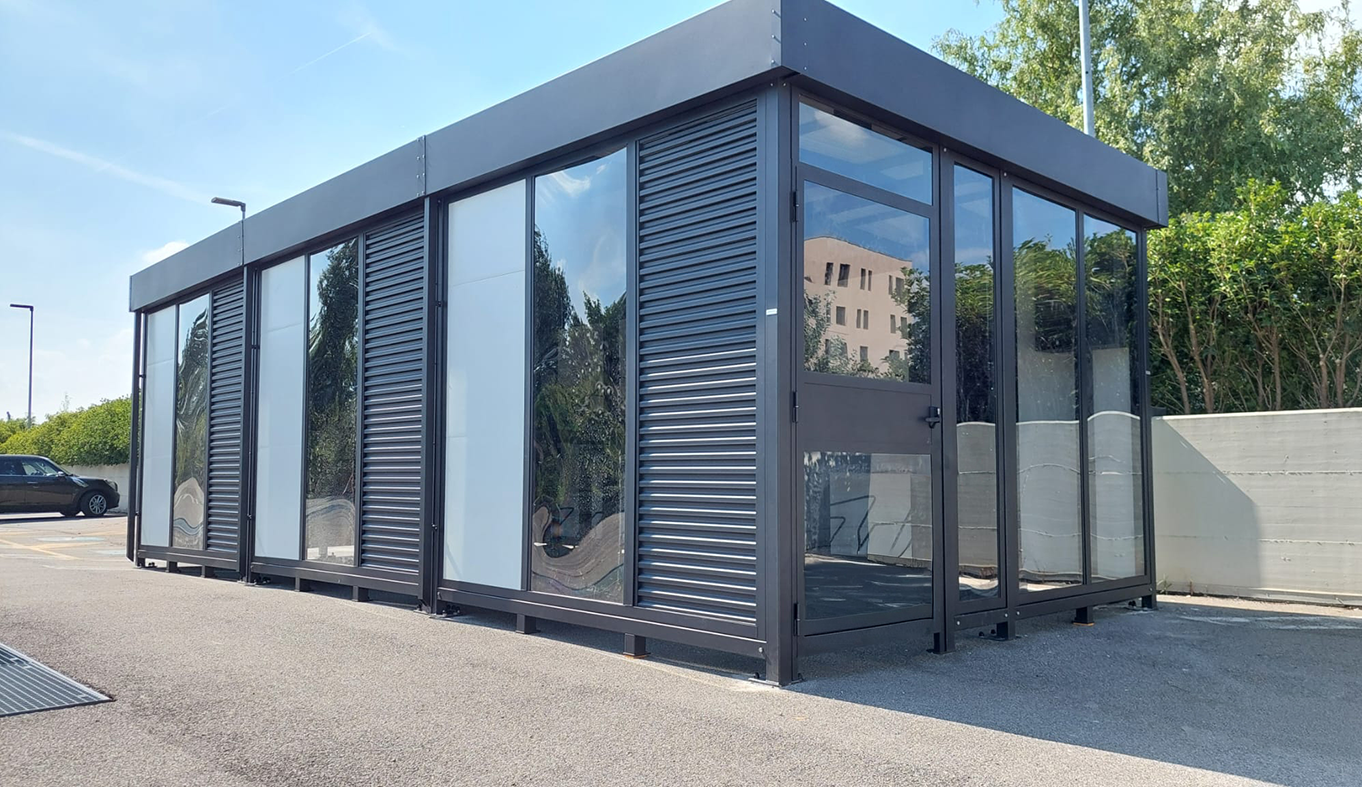
Bike Station

Dimcar bike hubs offer covered, secure and modular solutions for protected bicycle parking at railway stations, intermodal hubs, schools and corporate headquarters. Designed with load-bearing galvanized steel frames, perimeter cladding and integrable access control systems, they assist public administrations and mobility managers in actively promoting daily cycle commuting.
Customer service 800.677.233 - info@dimcar.it
Contact us
Code: 910
Struttura modulare DIMCAR per ciclostazioni e velostazioni, con ingressi controllati e configurazione dimensionale su richiesta del cliente.

Code: 912-M
Colonnina Bike Service per la manutenzione e riparazione delle biciclette, accessorio ideale per il completamento di ciclostazioni.

Code: 912-R
Colonnina Bike Service per manutenzione e ricarica di e-bike, con prese di alimentazione e kit di riparazione integrati.
Designing a bike station or a secure bicycle parking area requires careful evaluation of multiple technical and logistic factors: installation context, required stall capacity, anti-theft security levels, weather protection, integration with access control systems, and mandatory regulatory documentation for public works.
Dimcar supports public administrations, project managers (RUP), mobility managers, technical offices, designers, and contractors in selecting modular bike stations and secure, functional bicycle shelters compliant with the most advanced standards of sustainable mobility.
A bike station must be conceived in harmony with the transport ecosystem and the urban space in which it is integrated. Design requirements vary significantly between a railway interchange node, a underground station, a university campus, a large hospital complex, or a corporate parking area tied to mobility management policies.
In high-flow intermodal hubs, the primary objective is to guarantee high secure parking density and rapid access flows; in widespread or residential urban contexts, aesthetic and architectural integration with the surrounding landscape is equally relevant.
The resistance and longevity of a bike station depend on the excellence of the raw materials used and the surface treatments applied. The use of hot-dip galvanized and polyester powder-coated steel load-bearing frames ensures shape retention, high mechanical strength, and total protection against corrosion.
Perimeter infills and roofs can be configured with impact-resistant solid polycarbonate sheets, laminated safety glass, or micro-perforated solid panels, ensuring internal natural light, control visibility, and long-lasting resistance to weather agents and vandalism.
Before defining the supply, it is essential to analyze the extent of the available area, the number of bicycles and e-bikes to be housed, maneuvering paths, and any integration requirements with battery charging stations or light maintenance benches.
The modularity of Dimcar structures allows the development of bike stations of various sizes, configurable with single-tier or two-tier (space-saving) bike racks, partition walls, and controlled-access gates. For overall dimensions and construction details, it is always advisable to consult the technical data sheet.
A professional bike station must offer an impenetrable barrier against theft and weather. Closed perimeter structures and internal anchoring points allow both the frame and wheels of vehicles to be securely locked.
Furthermore, complete protection from rain, wind, and solar radiation preserves cyclists and bicycles during parking operations, actively promoting daily bicycle use in every season of the year (bike-to-work and bike-to-train).
Since a bike station effectively constitutes a structural metal construction work, regulatory compliance is a mandatory legal requirement. All Dimcar load-bearing structures are produced in compliance with the UNI EN 1090-1 standard with CE Marking, guaranteeing RUPs and designers the Declaration of Performance (DoP) and full compliance with Technical Standards for Construction (NTC), eliminating any risk during the final inspection.
Dimcar bike stations and cycling parking systems are designed and manufactured in full compliance with current ministerial decrees. The use of recycled and recyclable steels, the absence of hazardous substances in production cycles, and the complete disassembly of components at the end of their life cycle make Dimcar products the ideal choice to meet mandatory environmental requirements in public tenders.
Every Dimcar solution is developed so that no phase of its life cycle causes significant harm to the six environmental objectives defined by the European Union. Choosing Dimcar means incorporating suitable products into Sustainable Urban Mobility Plans (SUMP / PUMS) and regeneration projects that are fully compliant with funding linked to the NRRP (PNRR) and European funds.
Dimcar provides a transparent, objective, and certified mapping of the environmental impact of its solutions based on a Product Life Cycle Assessment (LCA). Dimcar's EPD documentation scientifically attests to the company's commitment to sustainability, providing project managers, designers, and technical offices with the certified data necessary for the environmental assessment of the project.
Properly integrating a bike station into a mobility plan or public tender requires precise data on dimensions, snow and wind loads, access systems, finishes, and product codes.
Dimcar provides technical support and up-to-date documentation for public administrations, technical offices, mobility managers, businesses, and contractors, helping you configure the structure best suited to available spaces.
Dimcar bike stations are created to offer secure, modular bicycle shelters with high aesthetic impact, designed to encourage active mobility and intermodality in urban, school, and corporate contexts. Our range includes protected structures, single boxes, and bicycle roofs designed to blend consistently into any collective space.
Choosing Dimcar means relying on the experience of an Italian manufacturer specialized in urban furniture. Each bike station is made with selected high-thickness steels, certified according to EN 1090-1 structural standards, and finished with protective cycles that guarantee maximum resistance to weather and intensive wear.
We offer extensive customization options regarding dimensions, perimeter closure types, RAL colors, and internal accessories, supporting the client with a technical consulting service at every stage, from design layout through to installation.
In full compliance with public procurement regulations and ecological transition, Dimcar bike stations comply with Minimum Environmental Criteria (CAM) and satisfy the DNSH principle. The entire range is also accompanied by the Environmental Product Declaration (EPD), which certifies the environmental impact of the entire life cycle, ensuring a sustainable and suitable choice for publicly funded projects.
The cost of a bike station varies based on multiple technical, dimensional, and structural parameters, ranging from compact modular shelters to large cycling hubs equipped with advanced locking systems. The main factors determining the price are:
To find out the exact investment for your project and receive a quote complete with technical data sheets for public tenders, contact our sales office for a free estimate.
To prepare an accurate, rapid financial proposal complete with technical specifications, it is ideal to provide us with the following details:
Even if you do not yet have all the technical data, our sales office is available to help you properly size the structure.
Yes, all technical documentation is structured to facilitate the work of designers, project managers (RUP), technical offices, and businesses:
This material allows you to verify footprints and regulatory compliance in complete autonomy; for specific design needs, our technical office is always active.
Dimcar bike stations are designed to stably withstand atmospheric agents and tampering attempts. Only certified raw materials are used:
The robustness of the metal profiles ensures the overall stability of the work even under harsh weather conditions.
Yes, Dimcar's production flexibility makes it possible to configure bike stations according to specific architectural and management requirements:
The Dimcar technical team supports designers and public bodies in developing custom solutions.
Installing a bike station requires careful planning of the support base to ensure certified structural stability:
The structure is supplied in a pre-assembled kit or with modular components to facilitate on-site assembly operations.
Dimcar bike stations are conceived to minimize routine and extraordinary maintenance:
Certainly. Thanks to the possibility of customizing finishes, RAL colors, and infill materials (opting for sober tones or protected inserts, for example), Dimcar bike stations can be integrated with balance even into historic urban contexts or areas subject to landscape protection.
Customer service 800.677.233 - info@dimcar.it
Contact us