

Smart street furniture: solutions, technologies, and benefits for public spaces
Today, public space is no longer just a place to be furnished, but a system to be operated. Squares, parks, stops, and urban areas must respond to increasingly complex needs: containing management costs, simplifying maintenance, offering services, and improving the quality of experience for those who live in them every day.
In this scenario, urban furniture evolves. It is no longer a passive element but becomes an active part of the city's functioning. This is where smart urban furniture comes into play: not technology for its own sake, but solutions designed to make spaces more efficient, more accessible, and easier to manage.
Understanding what "smart" truly means in this context is fundamental. It is not about imagining futuristic cities, but about introducing concrete tools, already applicable, capable of solving real problems.
What is meant by smart urban furniture and why is it increasingly important today?
Smart urban furniture integrates technologies that improve the function of elements within the public space. It means collecting data, automating processes, and offering additional services without complicating the user experience.
The difference compared to traditional furniture is substantial: it is not just the shape that changes, but the role. Benches, bins, or shelters become active components of the urban system.
This approach fits into the path of smart cities, where every element contributes to making the city more efficient, connected, and sustainable. But it is important to clarify one point: "smart" does not mean complex or futuristic. It means useful, functional, and designed to solve concrete needs.
Public administrations face very specific critical issues every day:
high operating costs
often non-optimized maintenance
difficulty in monitoring what happens in the urban space
increasing demand for services from citizens
Smart urban furniture responds to these needs directly. It allows for resource optimization, intervention only when necessary, and improvement of the quality of spaces without increasing management complexity.
In short: it is a functional evolution, even before a technological one.
Concrete examples of smart urban furniture and the technologies that make them possible
Smart urban furniture solutions are already a reality in many urban contexts. Some are now widespread and represent concrete examples of how technology can integrate naturally into public space.
Smart benches and photovoltaic benches
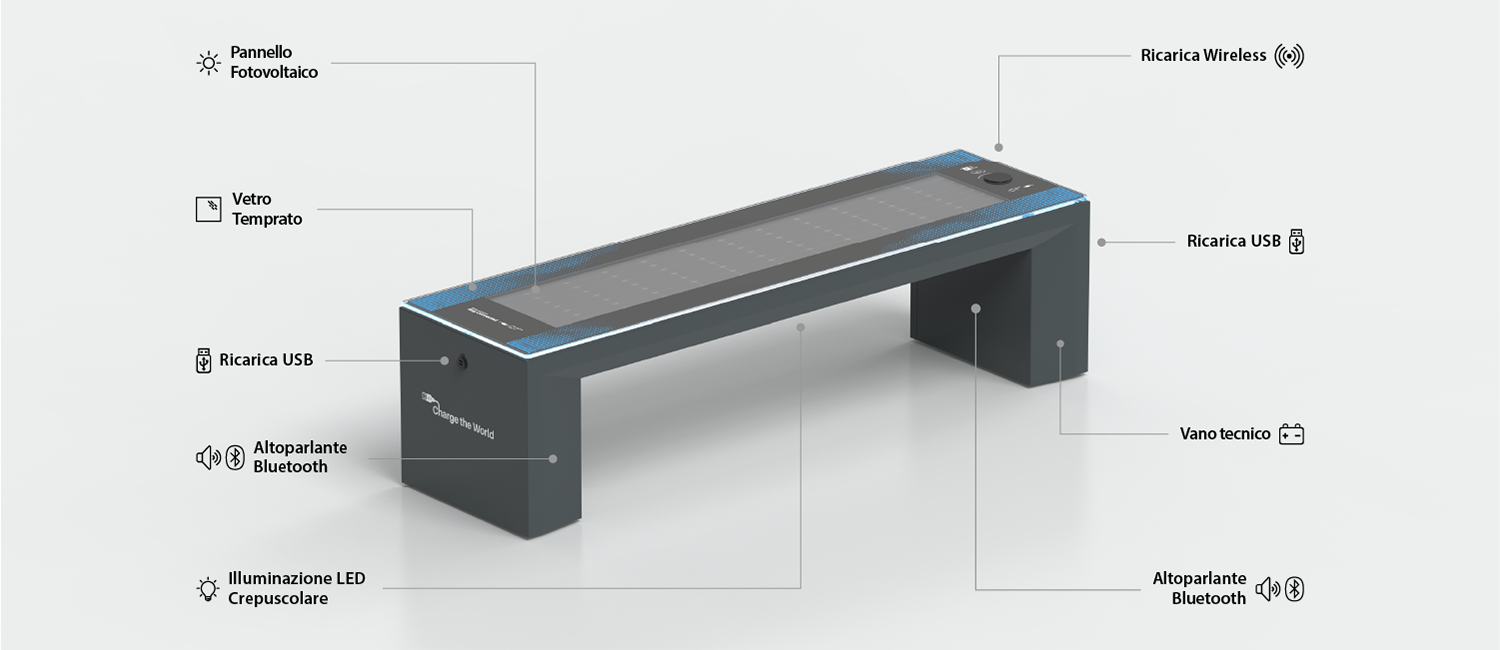
A bench can become much more than just a seat. Smart versions integrate charging systems for mobile devices, lighting, and connectivity, transforming into true service points.
The technological component is often powered by photovoltaic panels, which guarantee energy autonomy and reduce environmental impact. This allows them to be installed even in contexts where connection to the grid would be complex or expensive.
These are ideal solutions for squares, parks, waterfronts, and high-stay areas, where people stop, work, and socialize. The result is a tangible improvement of the urban experience without altering the aesthetic balance of the space.
Smart shelters with solar panels
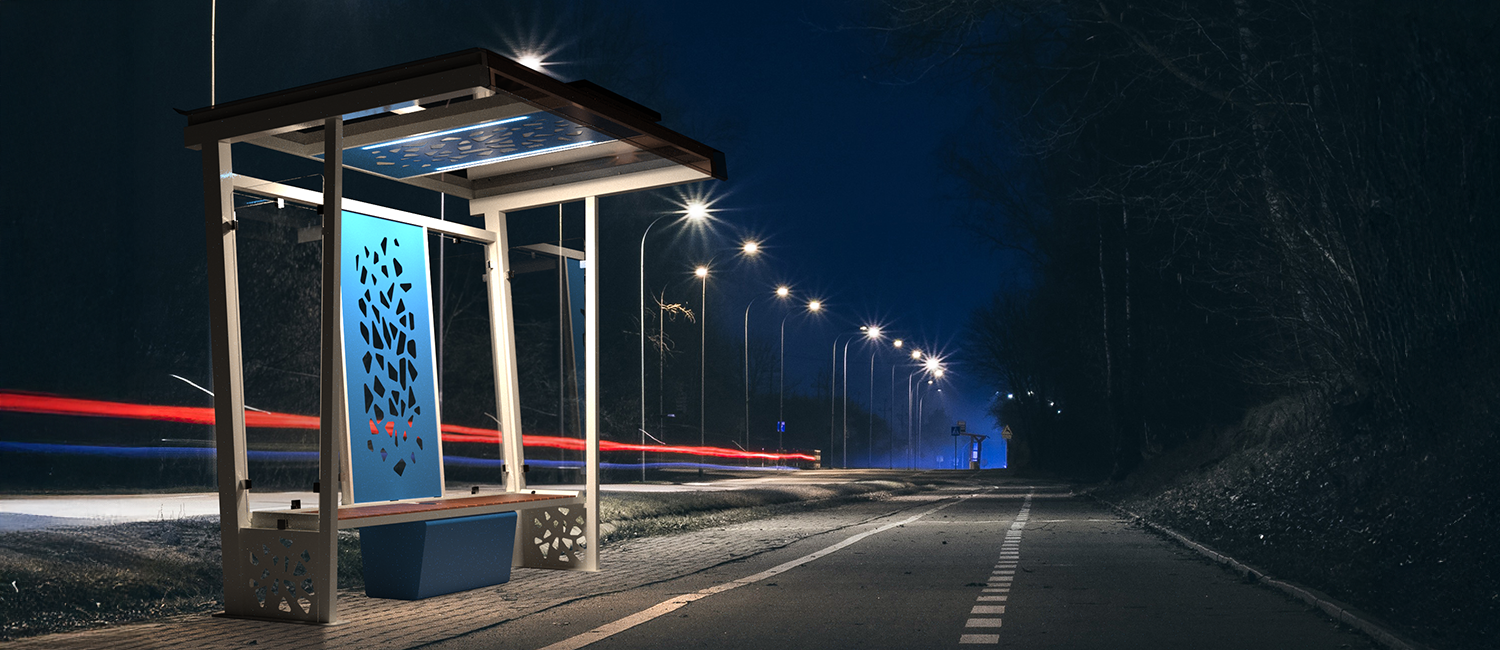
In the context of urban mobility, even waiting can be rethought. Smart shelters do not just offer cover, but integrate useful services such as real-time transport information, efficient lighting, SOS or emergency systems, and video surveillance devices. The installed solar panels contribute to making the shelter energy-autonomous for powering its integrated services. This evolution maintains the original function but enriches it. The experience becomes safer, more informed, and more comfortable, especially in high-traffic urban contexts.
This evolution maintains the original function but enriches it. The experience becomes safer, more informed, and more comfortable, especially in high-traffic urban contexts.
Smart bins with IoT sensors
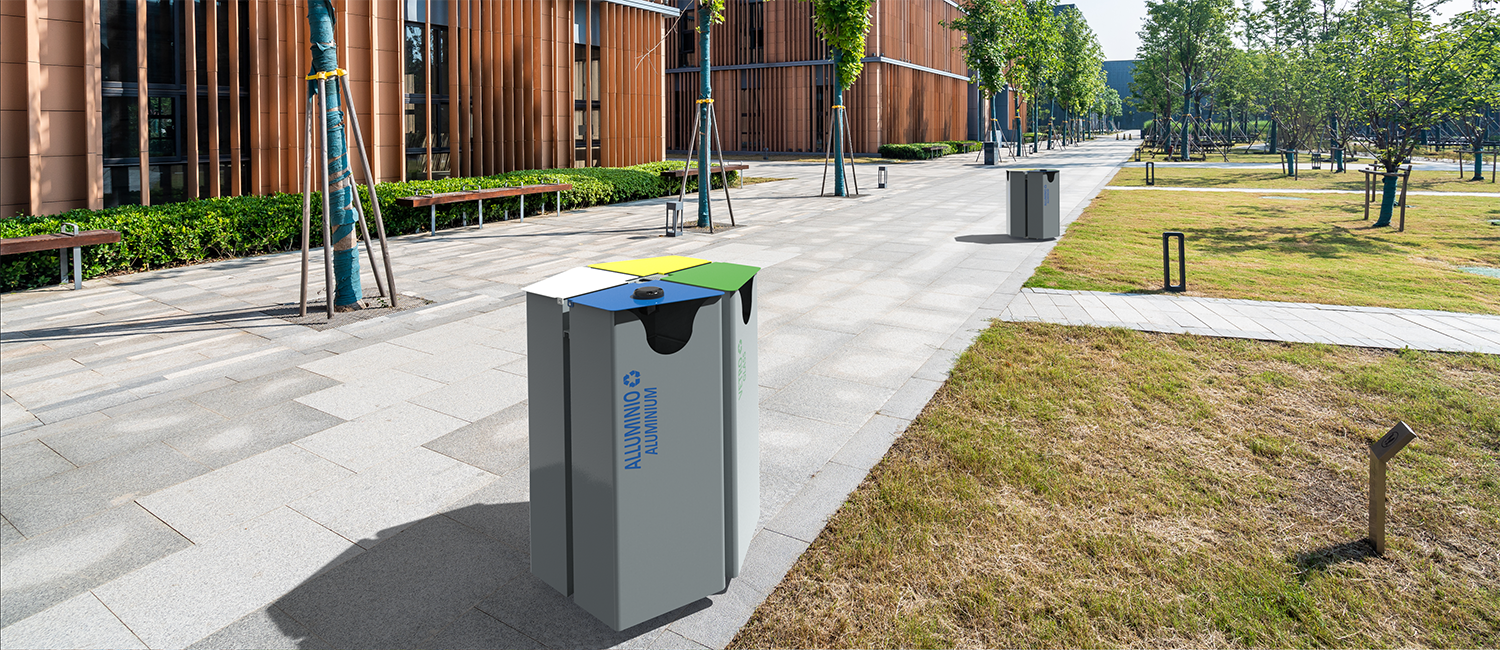
Smart bins represent one of the most concrete examples on the management side. Thanks to IoT sensors, they are able to detect the fill level and send real-time data.
Some models integrate fill-level detection systems with notifications for emptying needs, optimizing waste collection management. This allows for more efficient scheduling of interventions, reducing unnecessary trips by collection vehicles, containing operating costs, and helping to keep the urban space cleaner.
It is a solution simple in concept, but extremely effective in daily management.
The advantages of smart urban furniture
Smart urban furniture creates value on multiple levels, involving administrations, designers, and citizens.
For administrations, it means greater operational efficiency, more precise control, and cost optimization over time. The ability to collect data and intervene only when necessary reduces waste and improves overall management.
For designers, it represents an opportunity to integrate higher-performing solutions, capable of combining design, functionality, and innovation in a way that is consistent with the urban context.
Finally, for citizens, it translates into more comfortable spaces, accessible services, and a higher quality of urban experience.
The key point is this: better-designed furniture improves both the management and the daily use of the space.
Integrating smart urban furniture into a project: what really matters
Integrating smart solutions into an urban furniture project does not simply mean adding technology. A coherent design approach is needed, capable of starting from real needs.
The first step is exactly this: understanding the specific needs of the context. Not all solutions are suitable for every space, and the risk is introducing useless or oversized elements.
The choice of materials is equally central. Urban furniture must endure over time, against atmospheric agents and intensive use. Steel, wood, and quality treatments make the difference in terms of durability and maintenance.
Another fundamental aspect is management over time. The best solutions are those designed to simplify interventions, reduce costs, and ensure continuity of use.
In this scenario, value lies not only in the product but in the ability to accompany the project with technical expertise, vision, and attention to detail. These elements are part of the DNA of companies like Dimcar, which has been developing urban furniture solutions oriented towards quality, reliability, and concrete innovation for over 30 years.
Technology alone is not enough. The true goal is not to make cities more technological, but more livable.
Urban furniture truly works when:
it is used by people
it lasts over time
it integrates harmoniously into the space
it simplifies daily management
This is where "smart" finds its most authentic meaning: not to amaze, but to function better.